

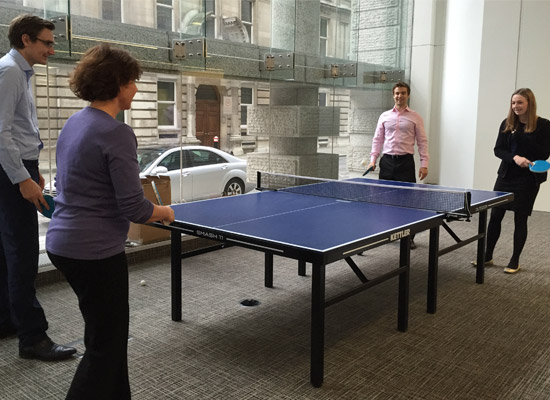
A table tennis table tends to become the centre of whatever room it lands in. Families play after dinner, teenagers bring friends over, and a garage that held boxes turns into a games room. Buying a ping pong table usually comes down to two early questions. Where will it live, and how seriously will people play? Prices in Australia run from around $550 for a basic indoor model to close to $7,000 for heavy outdoor tables, so getting those answers right first saves a lot of second guessing.
Measuring the Space First
The table itself is a fixed size. A full size table measures 2.74 metres long and 1.525 metres wide, with the playing surface 76 centimetres off the floor. That much is standard.
The space around it is what catches people out. Players step back from the table, move sideways and reach wide for awkward returns. A common guide for relaxed home play is a room of about 5.5 metres by 3 metres. Faster rallies need more. Competition areas are far larger still.
Ceiling height matters less for casual games, though lobs off low beams get annoying quickly. Doorways count too, since a folded table still has to fit through them on delivery day.
Indoor and Outdoor Tables Compared
The biggest split in the market is between indoor and outdoor tables. They look similar but are built very differently.
| Feature | Indoor table | Outdoor table |
| Playing surface | Wood or particle board, usually 16 to 25 mm thick | Weatherproof composite or resin, often thinner |
| Ball bounce | More even and lively | Slightly less consistent |
| Weather resistance | Can warp if left in damp or sun | Built to handle rain, heat and UV |
| Typical location | Rumpus room, garage, clubhouse | Patio, backyard, school grounds, parks |
| Price range | Usually lower for similar quality | Usually higher because of materials |
| Competition use | Thicker models can be ITTF approved | Mostly recreational |
An indoor table placed in a carport or under a pergola will often bow or blister after a wet season. An outdoor table placed indoors works fine, though it costs more and the bounce is not quite as true.
Why Tabletop Thickness Matters
The thickness of the top has a direct effect on how the ball behaves. Thin tops, around 12 to 16 millimetres, give a lighter, sometimes uneven bounce. They suit young children and occasional family games.
Tops of about 19 millimetres feel much more solid and are a good middle ground for regular home players. At 22 to 25 millimetres, the bounce becomes very consistent across the whole surface, close to what players find at a club.
International Table Tennis Federation rules ask for a ball dropped from 30 centimetres to bounce about 23 centimetres. Tables approved for competition are tested to meet that standard. For most homes, approval is not needed, but a thicker top is still noticeable from the first rally.
Folding, Wheels and Storage
Most tables sold for home use fold up when not needed. There are two common designs.
Single piece folding tables have both halves joined to one frame. One half can be lifted vertically so a single player can practise against it, which is handy for solo training. Two piece tables split into separate halves that roll away independently. They are easier to move through narrow doors, but setting them up takes a little longer.
Wheels make a big difference on larger tables, which can weigh well over 70 kilograms. Lockable wheels stop the table drifting during play. Safety locks on the folding mechanism are worth checking if young children will be around.
Matching the Table to the Players
Families with young children usually do well with a mid range indoor table, or a basic outdoor table if space inside is tight. A thick top matters less than a safe, sturdy frame.
Keen players who already play at a club will notice the difference a thicker indoor surface makes. For them, a heavier table with a top of 22 millimetres or more is closer to what they train on.
Schools, holiday homes and shared outdoor areas tend to suit tough outdoor models that can stay set up through the seasons. Some heavy duty outdoor tables are designed to remain in place permanently, with steel nets and frames that resist knocks.
A ping pong table that matches its space and its players will be used for years. One bought for the wrong setting tends to end up folded against a wall, slowly collecting boxes again.
