

The email is not a warning that you have been hacked. It is a warning that a password you used is now somebody else’s property.
The email arrives on a Tuesday. It is from your bank, or your email provider, or the antivirus package you bought three years ago and forgot about. The subject line contains the words dark web, and something in your chest tightens before you have read a single sentence.
Take a breath. The alert is real and it probably means something. It does not mean what you think it means.
What actually triggered it
Somewhere, a company you have an account with was breached. A database was copied. That database contained your email address, possibly a password hash, possibly a phone number, possibly an address. The data then appeared for sale or for free on a criminal forum.
A dark web scan does one simple, useful thing: it takes your email address and checks it against collections of known breaches. It does not watch criminals in real time. It does not know whether anyone has looked at your record. It cannot see a private conversation between a buyer and a seller.
Which means the alert is a statement about the past, not a prediction about the future. Somebody leaked your address. Nobody has necessarily done anything with it.
There is a timing problem as well. Breach data ages badly. A list compiled in 2019 does not tell you where you stand today, and it may not contain a password at all — sometimes it is an email address and a marketing preference, which is a much smaller problem dressed in the same alarming language.
What it does not mean
It does not mean your account has been accessed. Most breach data is never used individually. Big lists get sold in bulk, tested automatically against a hundred sites, and mostly discarded.
It does not mean your money is gone. It does not mean someone is in your email. It does not mean your computer has a virus — unless you have installed something strange, in which case this alert is not the thing to worry about.
The most common outcome of a breach alert is nothing at all. That is also why the alerts feel so unhelpful: they tell you that a risk exists without telling you whether it has landed.
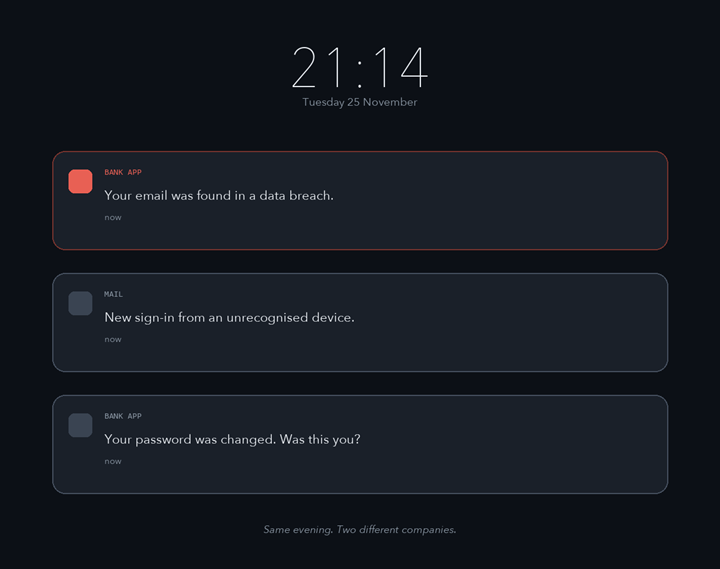
Three notifications, two companies, one evening. None of them are coordinated.
Why the alert is so vague
Because the company sending it usually does not know much either. It knows that a third party lost a database containing your address. It knows that the record was found in a certain collection. It does not know which password you used, whether you still use it, or whether you have already changed it.
There is a reason ‘what is dark web‘ is one of the most searched phrases in this whole subject. Millions of people receive these emails every year and then go looking for an explanation of the phrase in the subject line, because the email itself explained almost nothing.
What the alert email usually gets wrong
It implies surveillance. Phrases like “we monitor the dark web for you” suggest a live feed and somebody watching it. In practice, monitoring means matching your details against datasets that are already circulating, which is a different service with a much duller name.
It rarely says which password. Usually it cannot, because the breach record did not contain one, or contained a hash that is not the password itself.
It does not tell you whether the data is still current, because nobody knows. Most breach lists are stale within months.
None of that makes the alert worthless. It makes it a prompt, and a prompt only works if the reader knows what to do next.
The four things worth doing
In this order.
- Change the password on the account that was breached. Not a variation. A new one, generated, and stored somewhere that is not a spreadsheet.
- Change it anywhere else you reused it. This is the step that actually prevents damage, and the one most people skip. A leaked password is only dangerous where it still works.
- Turn on two-factor authentication, using an app rather than SMS. SIM swapping is its own industry, and a text message is not a strong second factor any more.
- Watch your inbox for a fortnight. Not for hacking, for phishing. The main use of a breached address is a well-crafted email that references the breach you just read about, and asks you to confirm your details to ‘secure’ the account.
When to worry properly
Two situations deserve more than the checklist above.
The first is password reuse across your email and anything financial. If one leaked, assume the other is exposed until you have changed both. Your email is the reset route for everything else you own, which makes it the single most valuable password you have.
The second is a breach that included identity documents — passport scans, national ID numbers, driving licences. Those do not expire when you change a password, and they are the raw material for loan fraud and account opening. That is a conversation with your bank and, in many countries, a credit reference agency, not a password reset.
There is a third situation that is less dramatic and much more common: the alert keeps arriving, every few months, for the same address. That usually means the address is in several old datasets and will be in more. The useful response at that point is not another password change. It is a password manager, so that the next breach costs you one account instead of six.
Otherwise, the correct response to a dark web alert is roughly the correct response to a smoke alarm: check, deal with the obvious cause, and do not spend the evening reading about house fires.
The same is true of identity monitoring. It is a smoke alarm, not a sprinkler. It tells you that a fire happened somewhere. It does not put one out, and a house without an alarm is not automatically in more danger than a house with three.
If the alert came from a company you have never heard of
This happens often, and the reason is dull. Your address was in somebody else’s breach, a monitoring firm bought the dataset, and it is now using the match to market itself to you. The alert is accurate. The sender is a stranger.
Check the claim yourself rather than clicking anything in the email. Search your address in a public breach checker, and treat an unsolicited message as marketing until it proves otherwise. A legitimate firm does not need you to sign in through a link it sent you at random.
The part the marketing leaves out
Paid monitoring services are not useless, but they are not a shield. They notify. The notification arrives after the breach, which is the only time it could arrive, and the work it prompts is done by you, in a password manager, on a Tuesday evening.
The good news is that the work is short. A unique password per account, an app-based second factor on the important ones, and a habit of not clicking links in emails about breaches will between them prevent almost everything this alert is warning you about.
That is a duller story than the one the subject line implies. It is also the one that keeps your account.
Notes for the editor
- Angle: consumer explainer written as a news-adjacent service piece.
- Links: two contextual, one to the checking tool and one to the definition.
- Images: one original illustration, also supplied as a standalone PNG.
- No fear-selling; no claim that an alert means an account has been accessed.
