

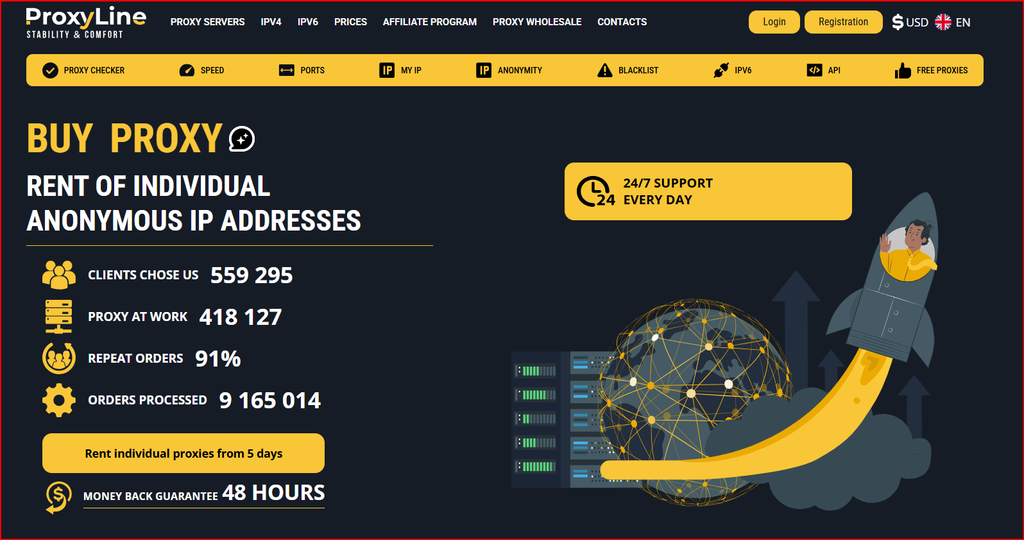
ProxyLine is a proxy provider I would shortlist when the job needs fixed endpoints, protocol flexibility and a low entry cost rather than a huge rotating residential pool. For this 2026 review, I focused on the things that matter after the marketing page: how the product line is separated, what the pricing actually encourages you to buy, where shared IPs create risk, how HTTP and SOCKS5 fit different workflows, and whether the available controls make the service practical for SEO, regional QA and automation.
Review snapshot
| Item | Review note |
|---|---|
| Best suited to | SEO research, localized QA, automation, dedicated browser profiles and fixed-IP tasks |
| Products reviewed | Shared IPv4, private IPv4, IPv6/32 and MTProto |
| Useful controls | HTTP/SOCKS5, city/subnet selection, IP binding and API access |
| Main caution | Shared IP reputation and target compatibility still need workload-specific validation |
How I approached this review
I treated ProxyLine as infrastructure rather than as a promise of anonymity or unlimited performance. I reviewed the product split, rental terms, protocol options, published management controls and current pricing. I also looked at what a buyer would need to validate before moving from a small order to a production batch. I did not convert provider speed statements into independent benchmark results; destination behavior, route quality and reputation can vary by target, location and time. That distinction matters because a technically working proxy is not automatically the right proxy for a specific website or workflow.
The product line is easier to understand than many proxy catalogs
The strongest part of ProxyLine’s offer is the clear separation between shared IPv4, private IPv4, IPv6/32 and MTProto. Shared IPv4 is the budget option and can make sense for low-risk research or tasks where perfect reputation control is not essential. Private IPv4 is the more predictable choice when one user or one workflow should control the endpoint. IPv6 is dramatically cheaper, but only useful when the destination and software stack genuinely support it. MTProto is specialized for Telegram-related connectivity rather than general web traffic. That product clarity reduces the chance of buying the wrong type simply because the price looks attractive.
Private IPv4 is the most balanced option for serious browser workflows
For most commercial browser workflows, private IPv4 is the category I would examine first. A dedicated address does not magically guarantee trust, but it removes the extra uncertainty created by another customer using the same endpoint at the same time. That is valuable for stable browser profiles, regional search checks, account administration that is permitted by the target service, and recurring QA. SOCKS5 support is useful when the application needs transport beyond ordinary browser HTTP traffic, while HTTP remains simple for scripts, browser settings and common automation libraries.
Shared IPv4 is cheap for a reason
The shared tier is attractive because the entry price is unusually low, especially for short rental periods. The trade-off is reputation control. If another user has recently triggered rate limits or abuse systems on the same address, your own task can inherit the consequences. I would therefore use shared IPv4 for expendable research, initial compatibility tests or workloads where retrying through another endpoint is acceptable. For anything revenue-sensitive, I would compare the cost savings against the time lost troubleshooting blocks, inconsistent pages or reputation-related friction.
IPv6 can cut cost, but compatibility decides whether the saving is real
IPv6/32 pricing is one of the most eye-catching parts of the catalog. The problem is that IPv6 support across websites, APIs and third-party software is still inconsistent. A cheap address that cannot reach the required destination is not a bargain. My preferred approach is to test the exact domains, login flows, payment pages, APIs and automation stack on a very small IPv6 order before scaling. When the complete workflow supports IPv6, the economics can be excellent. When it does not, private IPv4 is the safer operational default.
Geo and management controls add practical value
Manual city and subnet selection can matter more than a long country list. A buyer doing local SEO, localization QA or regional content checks often needs repeatable geography rather than random addresses from a broad national pool. IP binding can simplify authentication in controlled environments, while an API becomes important once inventory needs to be provisioned or rotated through internal tooling. These controls do not replace application-level session management, but they make the proxy layer easier to fit into a disciplined workflow.
Pricing: short rentals make testing inexpensive
ProxyLine’s pricing structure encourages a sensible evaluation strategy: start with a few addresses for five days, verify that they work with the actual destination and software, then extend only the endpoints that pass. The long-term price is still low, but the cheapest annualized option is not automatically the best choice if you have not tested reputation and compatibility first. Prices below are the published snapshot I reviewed in September 2026 and can change. ProxyLine pricing is the page I would re-check before purchase because providers can change prices and terms.
| Plan / quantity | 5 days | 30 days | 90 days | 360 days |
|---|---|---|---|---|
| Shared IPv4, 1-20 IPs | $0.67/IP | $0.99/IP | $2.97/IP | $11.88/IP |
| Private IPv4, 1-20 IPs | $0.96/IP | $1.77/IP | $5.31/IP | $21.24/IP |
| IPv6/32, 1-99 IPs | $0.10/IP | $0.51/IP | $1.53/IP | $6.12/IP |
| MTProto, 1-20 IPs | $0.96/IP | $1.77/IP | $5.31/IP | $21.24/IP |
What I would test before a larger purchase
My checklist would include destination reachability, IP geolocation accuracy, DNS behavior, authentication method, protocol compatibility, session persistence, rate-limit behavior and the time needed to replace a problematic endpoint. For browser work, I would also confirm that the browser profile, timezone, language and other client settings are consistent with the intended region. A proxy changes the network path; it does not automatically make the rest of the environment coherent.
Where ProxyLine fits best
The service makes the most sense for buyers who value low fixed-IP pricing and want a choice between shared, private and IPv6 endpoints. SEO teams can use it for regional checks, developers can use fixed addresses for integration testing, and automation teams can combine SOCKS5 or HTTP with their own tooling. It is less compelling for users who specifically need a large rotating residential network with household/mobile ASN characteristics, because that is a different product category.
Limitations that deserve attention
The biggest limitation is not unusual: proxy quality is partly destination-specific. Marketing claims about speed or stability cannot tell you how a particular marketplace, search engine or SaaS product will treat an address. Shared IPv4 adds reputation uncertainty, and IPv6 adds compatibility uncertainty. Buyers should also keep acceptable-use rules and target-site terms in mind. The correct purchase is the one that works technically and fits the intended use legally and operationally.
Pros and limitations
| Pros | Limitations |
|---|---|
| • Low entry pricing and five-day rental option | • Shared IP reputation is not fully under your control |
| • Private IPv4, shared IPv4, IPv6/32 and MTProto in one catalog | • IPv6 is not universally compatible |
| • HTTP and SOCKS5 support | • Provider speed claims still need workload-specific validation |
| • City/subnet selection and API controls | • Not a substitute for a rotating residential/mobile proxy network |
| • Good fit for fixed-IP workflows |
Buyer checklist
• Confirm the exact product tier and location required by your workload.
• Run a small pilot against the real destination before buying a large or long-term package.
• Verify limits, refund/replacement rules, bandwidth or traffic terms, and any extra licensing costs.
• Document the configuration that works so scaling does not introduce unrelated changes.
• Re-check the provider’s current terms at checkout because pricing and specifications can change.
Frequently asked questions
Does ProxyLine support SOCKS5?
Yes. The service advertises HTTP and SOCKS5 support for its general proxy products.
Should I choose shared or private IPv4?
Private IPv4 is the more predictable choice when endpoint reputation and consistency matter. Shared IPv4 is cheaper and can suit lower-risk testing.
Is IPv6 worth buying?
Only if the complete destination and software workflow supports IPv6. Test before scaling.
Can I rent for a short period?
Yes. The pricing reviewed included five-day rental terms, which is useful for compatibility testing.
Final assessment
ProxyLine is strongest when you want inexpensive fixed proxies with enough control to build a repeatable workflow. I like the short rental terms, clear private/shared split, SOCKS5 availability and low IPv6 pricing. I would not scale blindly: test the exact targets first, use private IPv4 when reputation control matters, and treat IPv6 as a cost optimization only after compatibility is proven. For buyers who understand those trade-offs, the service offers a practical price-to-control balance. ProxyLine official website is the best place to confirm the latest product details before ordering.
Pricing and specifications reviewed in September 2026. Provider plans, locations, limits and terms can change; confirm the live checkout page before purchase.
