

ProxyStores is a fixed-proxy provider whose catalog is built around shared IPv4, individual IPv4, IPv6/32 and MTProto. That sounds similar to several low-cost competitors, so the useful review question is not simply whether proxies are available. I looked at how the tiers differ, what HTTP/SOCKS5 support means for software compatibility, where the service fits regional research and automation, and which risks buyers should account for before they commit to a larger batch.
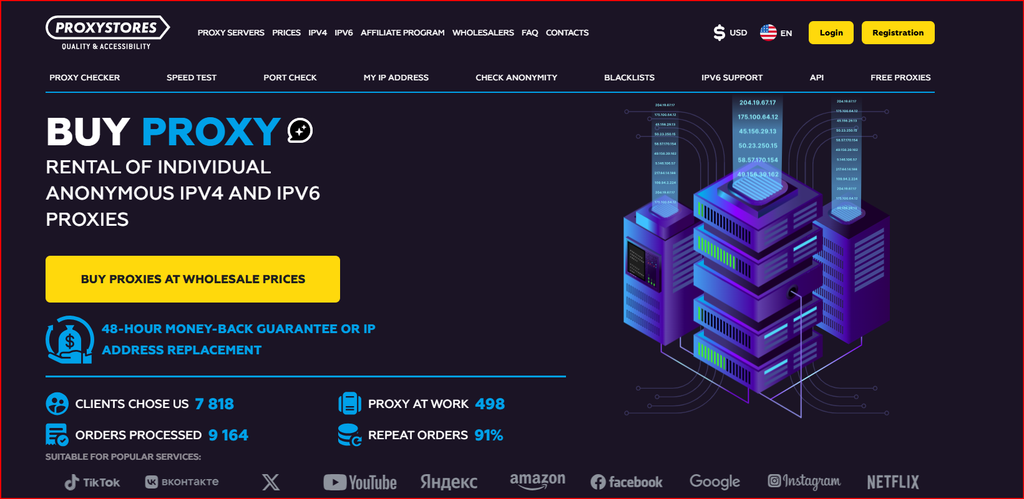
Review snapshot
| Item | Review note |
|---|---|
| Best suited to | Private IPv4 workflows, SEO research, regional QA, software integrations and MTProto use |
| Products reviewed | Shared IPv4, individual IPv4, IPv6/32 and MTProto |
| Useful controls | HTTP/SOCKS5, manual IP/subnet/city selection and IP binding |
| Main caution | The cheapest shared addresses carry the usual shared-reputation risk |
Review method: usability before hype
My evaluation concentrated on the public product structure, current pricing, protocols, management options, published support model and practical buyer decisions. I did not turn advertised speed into a benchmark claim. Proxy behavior depends on the destination, route, application and IP reputation. A high-quality review should therefore help the buyer choose the right tier and build a test plan, not pretend one speed number proves suitability for every task.
Shared and individual IPv4 solve different problems
Shared IPv4 is the low-cost choice. It can work for basic data gathering, public-page checks and disposable research, but the endpoint may be used by multiple customers. Individual IPv4 costs more and gives the buyer better control over concurrent use. For stable browser sessions, software that expects a fixed source address or workflows where reputation matters, individual IPv4 is the tier I would prioritize. The extra cost is small compared with the time spent debugging an address whose reputation you do not control.
SOCKS5 expands software compatibility
HTTP proxies are straightforward for browser and web-client traffic, while SOCKS5 is useful for applications that need a more general transport layer. That matters when a team uses desktop software, custom tooling or networking libraries that are not limited to HTTP requests. Protocol support does not guarantee every application will behave perfectly, so I would still test authentication and DNS behavior inside the exact client. But having both options prevents the proxy layer from dictating the entire software stack.
MTProto is specialized, not a general replacement
The MTProto product is intended for Telegram-oriented use and should be evaluated in that context. Buyers sometimes compare every proxy type only by price, which is a mistake. MTProto is not the general-purpose choice for browsers or ordinary API automation. The advantage of having it in the same catalog is convenience for teams that operate multiple legitimate workflows and prefer one supplier for general proxies and Telegram-specific connectivity.
Manual city, subnet and IP controls are useful for repeatable tests
ProxyStores advertises manual selection controls that can help localized QA and monitoring. In my view, repeatability is the key benefit. If a team is comparing content or search behavior across regions, it is easier to interpret results when the same or similar network context is maintained across runs. I would still verify the selected IP with external geolocation sources, because databases can disagree and a city label on a dashboard is not the only source of truth.
Pricing and the role of short-term rentals
The service’s low unit prices and five-day rental terms make it practical to perform a target-specific proof of concept. Rather than buying hundreds of addresses because the per-IP price is appealing, I would test a small number from the exact region, protocol and product tier required. If private IPv4 works consistently, scale that. If IPv6 works end-to-end, the cost can fall dramatically. If shared IPv4 is sufficient, use it where occasional replacement is acceptable. ProxyStores pricing options is the page I would re-check before purchase because providers can change prices and terms.
| Plan / quantity | 5 days | 30 days | 90 days | 360 days |
|---|---|---|---|---|
| Shared IPv4, 1-20 IPs | $0.67/IP | $0.99/IP | $2.97/IP | $11.88/IP |
| Private IPv4, 1-20 IPs | $0.96/IP | $1.77/IP | $5.31/IP | $21.24/IP |
| IPv6/32, 1-99 IPs | $0.10/IP | $0.51/IP | $1.53/IP | $6.12/IP |
| MTProto, 1-20 IPs | $0.96/IP | $1.77/IP | $5.31/IP | $21.24/IP |
Support and replacement should be part of the test
A proxy provider is not only an IP inventory. When a target rejects an address or geolocation is wrong, the support and replacement process becomes part of total cost. I would include at least one support interaction in a pilot: confirm the correct procedure, required evidence and response expectations. That reveals more than reading a support badge on a homepage. Operational responsiveness is especially important for agencies and teams managing client deadlines.
Best-fit workflows
ProxyStores is a practical fit for regional web checks, SEO research, fixed-IP automation, application testing and private browser profiles where the user has a legitimate reason to keep endpoints separate. It is also convenient for MTProto buyers. The product is less aligned with projects that specifically require residential/mobile ASN characteristics or automatic per-request rotation across a massive consumer IP pool.
The limitations are manageable if you plan for them
Shared reputation, IPv6 support and destination-specific blocks are the primary variables. Buyers should also remember that proxy use does not override a platform’s terms or access controls. The safest operational approach is to select the minimum-privilege product for a legitimate task, start with a small order, document results and scale only after compatibility is established.
Pros and limitations
| Pros | Limitations |
|---|---|
| • Clear shared vs individual IPv4 split | • Shared proxies can inherit other users’ reputation |
| • HTTP and SOCKS5 support | • IPv6 is not universally usable |
| • Low short-term pricing | • Published speed is not a destination benchmark |
| • MTProto available in the same catalog | • Not designed as a large rotating residential/mobile pool |
| • Useful location and IP controls |
Buyer checklist
• Confirm the exact product tier and location required by your workload.
• Run a small pilot against the real destination before buying a large or long-term package.
• Verify limits, refund/replacement rules, bandwidth or traffic terms, and any extra licensing costs.
• Document the configuration that works so scaling does not introduce unrelated changes.
• Re-check the provider’s current terms at checkout because pricing and specifications can change.
Frequently asked questions
Does ProxyStores support SOCKS5?
Yes. HTTP and SOCKS5 are part of the advertised proxy support.
Are private proxies available?
Yes. Individual/private IPv4 is offered separately from shared IPv4.
What is MTProto for?
It is a specialized proxy protocol associated with Telegram connectivity, not a general browser-proxy replacement.
Can I test before buying long term?
The reviewed pricing included five-day rental terms, which are useful for compatibility testing.
Final assessment
ProxyStores is most compelling as a straightforward fixed-proxy supplier with inexpensive entry pricing, individual IPv4, SOCKS5 and a useful MTProto option. The purchasing decision should be driven by the workflow, not by the cheapest number in the table. I would use private IPv4 for important sessions, test IPv6 separately and reserve shared proxies for work that can tolerate reputation variability and replacement. ProxyStores official website is the best place to confirm the latest product details before ordering.
Pricing and specifications reviewed in September 2026. Provider plans, locations, limits and terms can change; confirm the live checkout page before purchase.
