

SpaceProxy positions itself as a low-cost fixed-proxy platform with shared and individual IPv4, IPv6/32, MTProto, API access and unusually high published concurrency. My 2026 review focuses less on the headline numbers and more on what those features mean in practice: which tier fits which workload, how to think about 2,000-stream claims, why short rentals are useful, and what I would validate before trusting the service for recurring SEO, automation or geo-testing work.
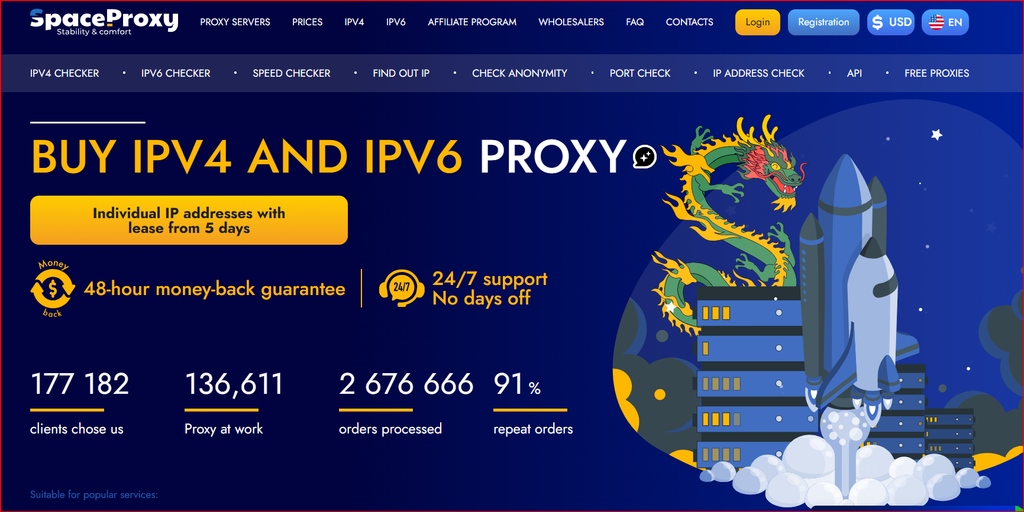
Review snapshot
| Item | Review note |
|---|---|
| Best suited to | SEO collection, automation, geo testing and high-concurrency fixed-proxy workflows |
| Products reviewed | Shared IPv4, individual IPv4, IPv6/32 and MTProto |
| Useful controls | API, city/subnet selection, auto-renewal and up to 2,000 published streams |
| Main caution | Concurrency and throughput claims remain destination- and workload-dependent |
What I evaluated
I reviewed SpaceProxy as an operational proxy service: product categories, protocols, location controls, published concurrency, pricing, refund/exchange information and automation features. I did not treat the provider’s capacity statements as a guaranteed result for every user. A proxy can have a fast uplink and still perform poorly against a specific destination because of routing, rate limits, IP reputation or application behavior. The useful question is whether the platform gives buyers enough control to test and scale responsibly.
The catalog covers the main fixed-proxy use cases
SpaceProxy divides its inventory into shared IPv4, individual IPv4, IPv6/32 and MTProto. That is a practical catalog for buyers who do not need rotating residential traffic. Individual IPv4 is the safer default for stable browser or software sessions because the endpoint is assigned to one customer. Shared IPv4 lowers cost when reputation control is less important. IPv6 is extremely inexpensive but must be proven against the target. MTProto serves a narrower Telegram-oriented use case.
The 2,000-stream headline needs the right interpretation
A large published stream allowance is useful for concurrency planning, but it is not the same thing as saying every destination will accept thousands of simultaneous requests. The target can enforce its own per-IP, per-session or behavioral limits. Local CPU, connection pools, DNS resolution and application design can also become bottlenecks. I see the high stream allowance as flexibility on the proxy side, not as permission to ignore target limits. A sensible load test should ramp gradually and record response codes, latency distribution and error rates.
Geo controls matter for QA and SEO
Country coverage is only one part of geographic testing. When a project needs localized search results, pricing pages, redirects or region-specific content, city and subnet selection can make the test more repeatable. I would still verify geolocation through more than one database because IP location datasets disagree. For recurring SEO collection, keeping a stable mapping between region, proxy and test profile makes trend data easier to interpret than randomly changing locations on every run.
API access improves repeatability
API support matters once proxy management becomes part of a larger workflow. Manual copying is fine for two or three endpoints; it becomes fragile when an internal tool needs to provision, label, renew or replace dozens. An API can reduce human error and make infrastructure reproducible. I would store credentials securely, log allocations and replacements, and avoid embedding secrets directly in scripts. Operational hygiene around the proxy layer is just as important as the proxy itself.
Pricing rewards small pilot tests
The pricing structure is similar across the provider’s fixed-proxy categories and includes five-day terms. That makes it easy to run a controlled pilot before making a longer commitment. My preference is to start with individual IPv4 for the critical target, add a small shared batch if cost pressure exists, and test IPv6 separately. Once success rates and compatibility are known, the buyer can decide whether longer rental terms improve economics without creating unnecessary lock-in. SpaceProxy plans and pricing is the page I would re-check before purchase because providers can change prices and terms.
| Plan / quantity | 5 days | 30 days | 90 days | 360 days |
|---|---|---|---|---|
| Shared IPv4, 1-20 IPs | $0.67/IP | $0.99/IP | $2.97/IP | $11.88/IP |
| Private IPv4, 1-20 IPs | $0.96/IP | $1.77/IP | $5.31/IP | $21.24/IP |
| IPv6/32, 1-99 IPs | $0.10/IP | $0.51/IP | $1.53/IP | $6.12/IP |
| MTProto, 1-20 IPs | $0.96/IP | $1.77/IP | $5.31/IP | $21.24/IP |
Refund and replacement rules should be read before purchase
SpaceProxy publishes refund and exchange information, but buyers should treat these policies as operational constraints rather than marketing reassurance. Replacement eligibility can depend on usage conditions and the reason an IP is considered unsuitable. Before purchasing a large batch, I would document the exact targets, test immediately after delivery and report issues within the provider’s stated window. That produces a cleaner support trail and avoids discovering policy limitations after a project is already blocked.
Best real-world uses
I see SpaceProxy fitting recurring SEO data collection, localized landing-page checks, software integration testing, fixed-region monitoring and automation that benefits from stable IPs. High concurrency can be valuable when the target allows it. Individual IPv4 is the tier I would use for important sessions; shared IPv4 is more appropriate for cost-sensitive research. The service is not positioned as a residential/mobile identity layer, so buyers requiring ISP or cellular characteristics should compare a different proxy category.
What could make a buyer unhappy
The service can disappoint buyers who read capacity claims as guaranteed end-to-end performance. IPv6 may fail on destinations that do not support it cleanly. Shared addresses may inherit reputation from other users. A location shown in one geolocation database may differ in another. None of these are unique to SpaceProxy, but they are reasons to run a target-specific pilot rather than judge solely by unit price.
Pros and limitations
| Pros | Limitations |
|---|---|
| • Very low fixed-proxy pricing | • High concurrency does not override destination limits |
| • Short five-day rental terms | • IPv6 compatibility varies |
| • Individual and shared IPv4 options | • Shared IP reputation remains uncertain |
| • API and city/subnet controls | • Not a rotating residential/mobile network |
| • High published stream allowance |
Buyer checklist
• Confirm the exact product tier and location required by your workload.
• Run a small pilot against the real destination before buying a large or long-term package.
• Verify limits, refund/replacement rules, bandwidth or traffic terms, and any extra licensing costs.
• Document the configuration that works so scaling does not introduce unrelated changes.
• Re-check the provider’s current terms at checkout because pricing and specifications can change.
Frequently asked questions
Does SpaceProxy offer private IPv4?
Yes. The catalog includes individual/private IPv4 as well as shared IPv4.
What does up to 2,000 streams mean?
It describes provider-side connection capacity, not a guarantee that every destination will accept that concurrency.
Is there API access?
Yes. API availability is one of the useful controls for automation and provisioning.
Should I start with IPv6 to save money?
Only after verifying that the target sites and software fully support IPv6.
Final assessment
SpaceProxy combines low prices, short rentals, geo controls and automation-friendly management in a package that is easy to pilot. Its value is strongest for teams that already know how to validate IP reputation, destination limits and IPv6 compatibility. I would start small, prefer individual IPv4 for important sessions and treat the large concurrency allowance as infrastructure headroom rather than a guaranteed application result. SpaceProxy official website is the best place to confirm the latest product details before ordering.
Pricing and specifications reviewed in September 2026. Provider plans, locations, limits and terms can change; confirm the live checkout page before purchase.
